

Higher education is undergoing rapid change. Students expect personalized, digital-first experiences from the moment they inquire to the day they graduate. Institutions face increasing competition, shifting demographics, and pressure to improve retention and alumni engagement.
The right CRM for higher education is no longer optional - it’s the backbone of enrollment management, student success, and advancement. Choosing wisely can mean the difference between siloed systems and a unified campus experience.
Choosing The Right CRM
For Higher Education
Why Choosing The Right CRM Matters
Critical Capabilities Every Higher Education CRM Should Include
A strong higher-ed CRM should address the entire student lifecycle - not just one part of it. These capabilities form the foundation of long-term success.
A Unified Data Model Designed for Higher Ed
Multiple systems mean mismatched records, inconsistent data, and manual reconciliation. Your CRM should offer:
A single source of truth
Consistent fields and structures for higher-ed workflows
Real-time updates across departments
Ease of Use for Non-Technical Staff
A CRM should not require coding or consultants for everyday tasks. Functional users should easily manage:
Automations
Data updates
Communication plans
Portal configuration
Lifecycle Coverage — From Prospect to Alum
The CRM must support:
Admissions & recruitment
Enrollment & onboarding
Student success & retention
Advising & communications
Advancement & alumni relations
Lower Total Cost of Ownership
Consider not only subscription costs but:
Required add-ons
Integration expenses
Consulting & admin time
Training & ongoing support
Built-In Tools (Not Add-Ons)
Adding modules increases cost and complexity. Look for a CRM that includes:
Email & SMS communications
Event management
Forms & portals
Workflow automation
Reporting & analytics
Higher Education-Specific Roadmap
Your CRM’s roadmap must evolve with higher-ed—not corporate sales priorities. Prioritized updates should reflect:
Enrollment trends
Retention-focused innovations
Changing communication needs

What To Look For in a Higher Ed CRM
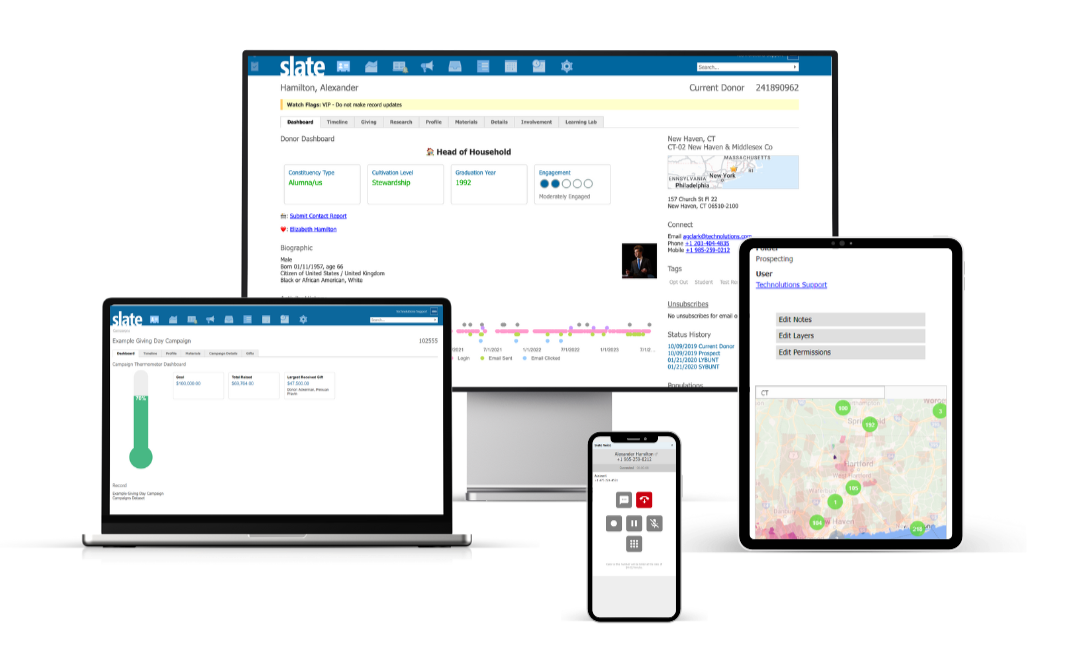
Slate is designed to grow with your business, continuously evolving with new features and real-time updates at no additional cost, ensuring you always have leading edge technology to stay ahead without worrying about additional fees.
Key Questions To Ask
When Evaluating CRMs
Questions That Should Guide
Every CRM RFP Or Product Demo

Before Committing To a CRM Ask:
-
Was this platform built specifically for higher ed?
How closely does the roadmap align with our institution’s goals?
-
Which tools are included natively?
What requires add-ons, integrations, or third-party vendors?
Does the CRM support the entire student lifecycle?
-
What does the total cost look like over 3-5 years?
Are consultants required for implementation or ongoing maintenance?
Are there separate licensing fees for different clouds or modules?
-
What is the typical implementation timeline?
How dependent will we be on vendor services or outside partners?
-
Can functional users build and maintain workflows without coding?
How intuitive is reporting and dashboard creation?
-
How does the CRM protect sensitive student information?
What controls exist around roles, permissions, and access?
-
Can the platform grow with our enrollment, programs, or modalities?
How does the system perform with high-volume data or peak periods?
-
Time, effort, and cost required to maintain the system
How are system upgrades managed/implemented?
CRM Comparison: Salesforce VS. Slate
Here’s How Salesforce and Slate Stack Up Against Strategic Goals:
Slate provides comprehensive, native functionality that does not require licenses to third-party tools, such as:
| HOW SALESFORCE APPROACHES IT | HOW SLATE ACHIEVES IT | |
|---|---|---|
| REDUCE SYSTEMS | Requires multiple clouds (Sales, Service, Marketing, Education) and partner apps to achieve full functionalty. | All-in-one enterprise platform consoidates CRM, communications, events, portals, forms, and payments. |
| LOWER TOTAL COST OF OWNERSHIP (TCO) | Licensing costs grow with each additional module and integration. Ongoing consulting typically required. |
Single subscription includes core capabilities with minimal add-ons or services needed. |
| STANDARDIZE DATA & IMPROVE TRUST | Data often spread across multiple products and integrations, requiring ongoing sync and governance. | Unified data model ensures a single source of truth for the entire student lifecycle. |
| ACCELERATE DIGITAL TRANSFORMATION | Implementation is typically phased over 12-24 months with significant custom development. | Purpose-built workflows and features deploy quickly - often in weeks or months. |
| ENHANCE STAKEHOLDER EXPERIENCE | Experience is often fragmented across tools and requires integration to unify. | Unified platform creates seamless experiences across recruitment, enrollment, and advancement. |
| REDUCE RISK & COMPLEXITY | Customization-heavy deployments increase risk, maintenance burden, and security exposure. | Out-of-the-box functionality minimizes integrations and lowers the attack surface. |
| EMPOWER CAMPUS TEAMS | Most changes require admin or developer involvement. | Functional users manage forms, workflows, portals, and communications with no code. |
| FUTURE-PROOF TECHNOLOGY STACK | Broad enterprise roadmap not tailored to higher ed priorities. | Roadmap driven entirely by higher ed community feedback and evolving institutional needs. |
| SALESFORCE OFFERS A TOOLKIT Most instiutions spend significant time and money turning it into a workable solution. |
SLATE IS THE SOLUTION Purpose-built for higher ed, ready to deliver value on day one, and designed to grow with your institution without adding complexity. |
Benefits Summary for CIOs
What CIOs Gain From a Purpose-Built CRM

Faster Implementation = Quicker time to value
Lower Long-Term Cost = Fewer modules, fewer external consultants
Unified Data = Institutional confidence in reports and dashboards
Greater Agility = Rapid response to enrollment or market changes
Future-Ready = Platform evolves with higher-ed priorities
See Why More Than 2,000 Institutions Trust Slate
Slate delivers a unified, purpose-built platform designed exclusively for higher education - and built to grow with your institution.